NABL Accredited Laboratory as per ISO/IEC 17025:2017  ISO Certified Laboratory

Our Services

Comprehensive geotechnical investigation solutions for every project type and scale

Full-Spectrum Geotechnical Services

From initial site reconnaissance to comprehensive foundation recommendations — we cover every aspect of subsurface engineering investigation.

Modern Soil Investigation Solutions

We combine field expertise, modern testing, and clear reporting so foundations are designed with confidence.

  • Onsite borehole and sampling precision
  • NABL-grade lab testing and analysis
  • Foundations designed for safety and economy
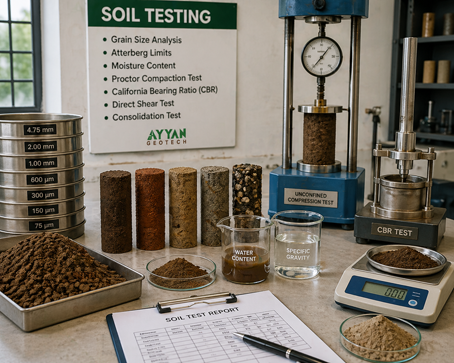
Soil testing and geotechnical services

Soil Testing

Comprehensive laboratory and field testing to characterize soil properties essential for safe foundation design.

  • Grain Size Analysis (Sieve + Hydrometer)
  • Atterberg Limits (LL, PL, PI)
  • Proctor Compaction Test
  • California Bearing Ratio (CBR)
  • Triaxial & Direct Shear Test
  • Consolidation / Oedometer Test
Request This Service

Standard Penetration Test (SPT)

In-situ SPT testing as per IS:2131 for real-time soil resistance measurement and N-value determination.

  • N-Value Determination
  • Bearing Capacity Estimation
  • Soil Liquefaction Assessment
  • Foundation Type and Depth Recommendation
  • IS:2131 Compliant Reporting
Request This Service

Plate Load Test (PLT)

Direct measurement of subgrade bearing capacity and settlement behavior as per IS:1888 for pavement and foundation design.

  • Safe Bearing Capacity
  • Settlement Characteristics
  • Modulus of Subgrade Reaction (k)
  • Load Settlement Analysis
  • Cyclic Plate Load Test
Request This Service

Foundation Analysis

Detailed engineering analysis and design recommendations based on soil investigation data for all structure types.

  • Shallow Foundation Design (Isolated / Raft)
  • Deep Foundation Analysis (Pile)
  • Settlement Analysis
  • Bearing Capacity Calculations
  • Foundation Depth Optimization
  • IS:6403 / IS:2911 Based Reports
Request This Service

Ground Improvement

Engineering solutions to improve poor ground conditions and enable safe construction on challenging sites.

  • Stone Column Installation
  • Soil Stabilization (Lime/Cement)
  • Grouting & Injection
  • Geosynthetic Reinforcement
Request This Service

Why Soil Testing Comes First

Accurate subsurface investigation is the foundation for safe, economical design and ensures the correct foundation system is selected for every project.

Our Investigation Process

1
Site Visit & Reconnaissance

Initial site inspection and review of existing data to plan the investigation programme.

2
Scope & Quotation

Detailed scope of investigation with transparent pricing submitted within 24 hours.

3
Field Investigation

Borehole drilling, in-situ testing, and sample collection by our experienced field team.

4
Laboratory Testing

Samples analyzed in our accredited laboratory using calibrated equipment per IS standards.

5
Report & Recommendations

Comprehensive geotechnical report with soil profiles, test results, and foundation recommendations.

What Our

Geotechnical Report Delivers

Our detailed geotechnical reports include all essential data for safe and economical foundation design, such as:

  • Determination of Safe Bearing Capacity (SBC) of soil at appropriate depths for the recommended foundation type
  • Settlement analysis using appropriate methods based on soil characteristics
  • Detailed pile load carrying capacity calculations for axial, uplift, and lateral loading conditions

Additional deliverables such as soil profiles, laboratory test results, recommendations for ground improvement (if required), and detailed foundation design suggestions are also provided.

Need a Geotechnical Investigation?

Get a free quotation within 24 hours. We cover residential, commercial & infrastructure projects.

Importance of Soil Testing

Proper soil testing gives engineers the data needed to design safe foundations and avoid future problems.

  • Soil testing identifies the strengths and limitations of subsurface soil to support safe foundation design.
  • Buildings designed using proper soil investigation data achieve greater safety, reliability, and long-term performance.
  • Understanding soil behavior in advance helps prevent settlement cracks and costly repairs.
  • Evaluating the nature and stratification of soil deposits at the site.
  • Determining the strength and load-bearing capacity of soil at various depths.
  • Identifying weak or problematic soil layers beneath the ground surface.
  • Recommending the most suitable and safe foundation system for the structure.